
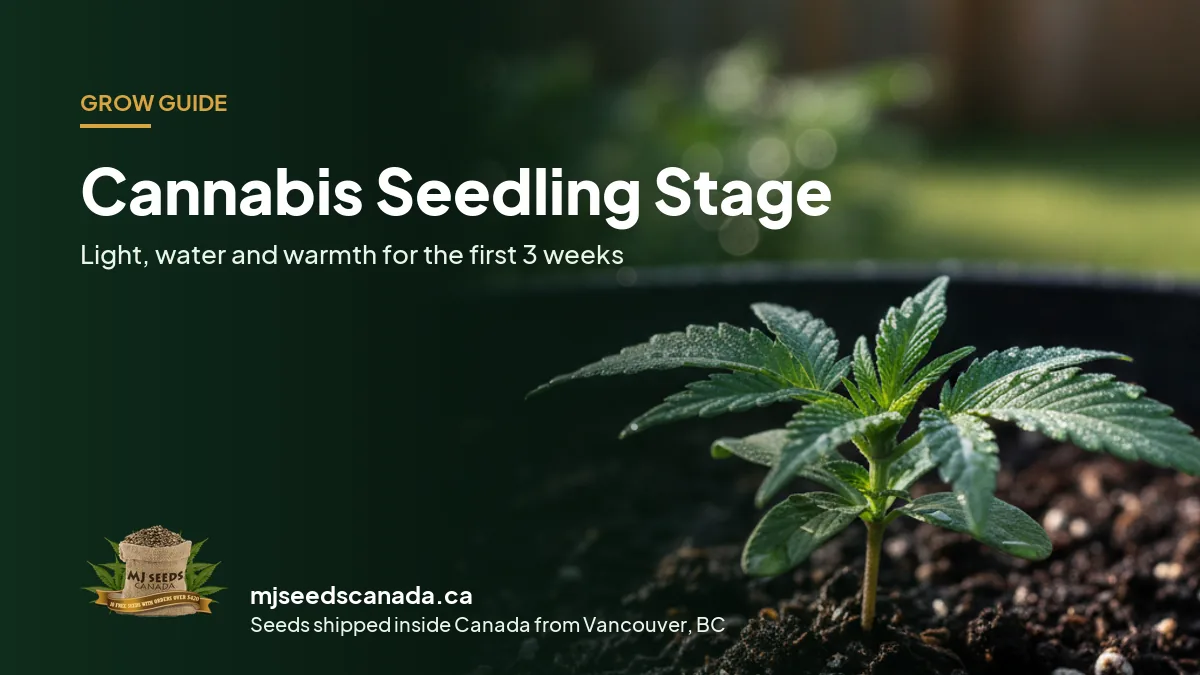
The cannabis seedling stage lasts about 2 to 3 weeks, from the moment the seed leaves open until the plant has 3 to 4 sets of true leaves. Give seedlings 18 hours of gentle light, 22 to 26 degrees, 60% to 70% humidity and small, careful waterings.
Last updated: October 2026
Seedlings are the most fragile plants you will ever grow, and most failed first grows go wrong in these first three weeks, not at harvest. The good news is that seedlings need less than people think: soft light, warm air, a little moisture and patience. Most problems come from doing too much, especially too much water and too much fertilizer.
This guide gives you the numbers for each part of the stage, a day by day timeline, how to spot trouble early and when to move seedlings into bigger pots. It also covers what changes in Canada, where seedlings are often started in cold basements in March and April and hardened off for a short outdoor season.
The seedling stage usually lasts 2 to 3 weeks for photoperiod plants and about 2 weeks for autoflowers. It begins when the sprout breaks the surface and opens its two round seed leaves (cotyledons), and it ends when the plant has 3 to 4 sets of true leaves with the full number of leaf fingers for its strain, usually 5 to 7. At that point it moves into the vegetative stage and growth speeds up sharply.
Cool rooms stretch the stage. A seedling kept at 18 degrees in an unheated Canadian basement can take 4 weeks to do what a seedling at 24 degrees does in 2. Strain matters a little too: indica leaning plants make short, wide leaves early, while sativa leaning seedlings look taller and thinner from the start.
Cannabis seedlings need 18 hours of light and 6 hours of darkness a day, at a gentle intensity of roughly 100 to 300 µmol/m²/s (PPFD). That is a quarter to a third of what a flowering plant wants. Some growers run 24 hours of light; it works, but a short dark period gives roots a rest and costs nothing.
Intensity matters more than hours. Too little light and the seedling stretches into a thin, floppy stem that falls over. Too much and the leaves curl up, bleach or turn crispy at the edges. With a full spectrum LED, start with the dimmer at 25% to 40% or the light at the height the manufacturer recommends for seedlings, often 60 to 90 cm. Raise intensity a little each week as the leaves widen.
A sunny Canadian windowsill in March or April gives only a few hours of strong light and a long, cold night, which is why windowsill seedlings so often stretch. A small LED or even a pair of shop lights over a seedling tray is the single best upgrade for a spring start.
Cannabis seedlings do best at 22 to 26 degrees with lights on, no lower than about 18 degrees at night, and 60% to 70% relative humidity. Young roots grow slowly in cold soil, and the tiny leaves cannot pull much water yet, so warm, humid air keeps them from drying out.
| Condition | Seedling target | Signs it is off |
|---|---|---|
| Day temperature | 22 to 26 °C (72 to 79 °F) | Below 20 °C: slow, purple stems; above 30 °C: drooping, curled leaves |
| Night temperature | 18 to 22 °C | Colder nights stall growth and invite damping off |
| Relative humidity | 60% to 70% | Below 40%: crispy tips; above 80% with no airflow: mould on the soil |
| Light hours | 18 on, 6 off | Long nights or weak light: stretched, thin stems |
| Light intensity | 100 to 300 µmol/m²/s | Bleached or taco-shaped leaves mean too strong |
| Water pH | 6.0 to 7.0 in soil, 5.5 to 6.5 in coco | Pale, spotted leaves despite good care |
In a dry Canadian winter, indoor humidity often falls to 20% or 30%. A clear humidity dome over the tray, or a small humidifier in the tent, fixes that. Lift the dome a little more each day after the first week so seedlings toughen up, and keep a small fan moving the air gently, never blasting the plants.
Water cannabis seedlings only when the top centimetre of the medium is dry, which is usually every 2 to 3 days in small pots, using small amounts poured in a ring around the stem. Overwatering is the most common way seedlings die, because waterlogged soil starves the young roots of oxygen and invites root rot and damping off.
A seedling in a giant pot of wet soil is a classic mistake: the roots cannot use that much water, and the soil stays soggy for days. Starting in a 0.5 to 1 litre pot or a solo cup with drainage holes makes watering far easier to control.
Most cannabis seedlings need no fertilizer for the first 2 weeks, because the seed and a light seedling mix supply what they need. Start feeding once the third set of true leaves appears, at a quarter to half of the label strength for a vegetative formula, and only if the leaves begin to pale.
Hot potting soils that are pre-loaded with fertilizer can burn seedlings: look for brown, crispy leaf tips or leaves that claw downward. If that happens, switch to plain water for a week and use a lighter seedling or seed-starting mix next time. Coco and hydroponic seedlings are the exception; those media have almost no nutrients, so a very weak feed (EC around 0.4 to 0.8) from the first true leaves is normal. A seed-starting mix with little or no added fertilizer is the safest choice for young plants.
Transplant cannabis seedlings when they have 3 to 4 sets of true leaves and white roots are visible at the drainage holes, usually 2 to 3 weeks after sprouting. Moving them too early disturbs a tiny root ball; moving them too late lets roots circle the pot and slows growth.
Most seedling problems show up as stretching, drooping, yellowing or a stem that suddenly collapses, and each one points to a fairly simple cause.
For an outdoor grow in Canada, start photoperiod seedlings indoors 3 to 5 weeks before your last frost, then harden them off for a week before planting out. In most of southern Canada that means sowing in mid to late April and planting out in late May; on the Prairies and in the Atlantic provinces, early June is often safer. Our outdoor planting dates by province give the timing for each region.
Hardening off is simple. For 7 to 10 days, put the seedlings outside in shade for an hour or two, then a little longer and a little sunnier each day, bringing them in at night. Wind and full sun on an unprepared seedling can bleach and snap it in an afternoon.
Keep the plant count in mind. Under federal rules adults can grow up to four cannabis plants per household, subject to provincial limits, and Health Canada explains the safe home growing basics in its page on growing cannabis at home safely. Quebec does not allow home growing, and Manitoba allows four plants indoors only. Many growers germinate a few extra seeds and keep only the strongest seedlings, so check your local limits before you pop more than you can keep.
Autoflower seedlings need the same warmth, humidity and gentle watering, but they should be planted straight into their final pot and kept on 18 to 20 hours of light from day one. Because an autoflower starts flowering on its own after 3 to 5 weeks, any transplant shock or early stress steals growth it can never make back.
Skip topping during the seedling stage, keep feeding light and resist the urge to repot. A healthy autoflower seedling that never stalls is the biggest single factor in its final yield.
Five seedling habits that prevent most failures
The cannabis seedling stage usually lasts 2 to 3 weeks. It starts when the seed leaves open and ends when the plant has 3 to 4 sets of true leaves with their full number of fingers. Cool rooms below 20 degrees can stretch it to 4 weeks.
Cannabis seedlings do best with 18 hours of light and 6 hours of darkness each day. Keep the intensity gentle, around 100 to 300 µmol/m²/s, and raise it slowly as the leaves widen. Weak or distant light makes seedlings stretch and fall over.
Water cannabis seedlings only when the top centimetre of the medium is dry, which is usually every 2 to 3 days in a small pot. Give 30 to 60 ml in a ring around the stem. Overwatering is the most common cause of seedling death.
Most cannabis seedlings in soil need no fertilizer for about 2 weeks. Start at a quarter to half strength once the third set of true leaves appears and only if the leaves begin to pale. Coco and hydro seedlings need a very weak feed earlier.
Yellow seed leaves are normal once true leaves take over. Yellowing true leaves usually point to overwatering, cold roots, a pH problem or a hot soil that burned the roots. Check the soil moisture and temperature before adding any nutrients.
Transplant cannabis seedlings from solo cups when they have 3 to 4 sets of true leaves and roots are showing at the drainage holes, usually 2 to 3 weeks after sprouting. Water lightly a few hours before so the root ball slides out in one piece.
Healthy seedlings start with healthy seeds: every batch we sell is viability tested in Vancouver, ships inside Canada in plain packaging and is covered by our 80% germination guarantee. Browse our feminized cannabis seeds to plan your next grow.
You must be of legal age to view cannabis seed content in your region.
By entering you agree to our Terms of Service.