
🎁 10 FREE seeds with orders over $420 · Free shipping over $200 · Germination guaranteed
$65.00 – $240.00Price range: $65.00 through $240.00
Grape Pie strain seeds grow the purple dessert indica that sits behind half of today’s grape crosses: Cherry Pie crossed with Grape Stomper, testing 18% to 25% THC with a nose of grape jam, dark cherry and warm pie crust. It is about 70% indica, flowers in 8 to 9 weeks and stays between 80 and 130 cm indoors, with dense buds that often turn violet in a cool finish. The effect begins with an easy, cheerful lift and ends with a heavy body calm. Every feminized seed is already in Canada, packed in Vancouver, BC and delivered domestically in 3 to 7 business days.

| Pack Size | Price | Quantity | |
|---|---|---|---|
| 5 Seeds | $65.00 | ||
| 10 Seeds | $120.00 | ||
| 25 Seeds | $240.00 |
Viability-tested seeds. If they don’t pop following our germination guide, we replace them.
Encrypted SSL checkout. Your card statement shows a neutral company name, never cannabis.
Ships from Vancouver, BC in 3 to 7 days, plain packaging with no cannabis branding.
Live chat 7 days a week, plus growing guides written for Canadian climates.
| Genetics | Cherry Pie x Grape Stomper |
|---|---|
| Type | Indica dominant hybrid (70/30) |
| THC | 18%–25% |
| CBD | Under 1% |
| Flowering time | 8–9 weeks (56 to 65 days) |
| Outdoor harvest | Late September to early October |
| Height indoor / outdoor | 80–130 cm / up to 180 cm |
| Yield indoor / outdoor | 400–500 g/m² / 500–800 g per plant |
| Difficulty | Moderate |
| Climate | Warm, settled days; a cool night drop in the last fortnight for purple |
| Best for | Grape and pastry flavour, evening use, parent stock for grape crosses |
Grape Pie Feminized at a glance: Grape Pie is a 70/30 indica leaning cross of Cherry Pie and Grape Stomper that flowers in 8 to 9 weeks, tests 18% to 25% THC, grows 80 to 130 cm indoors and yields 400 to 500 g/m² of dense, frosty, often purple buds that smell of grape jam, cherry and baked pastry.
The same warm, dry late summers that ripen wine grapes in the Okanagan, on the Niagara Peninsula and in Prince Edward County suit an 8 to 9 week indica like Grape Pie. The seeds start their trip in Vancouver, BC, where we keep them in stock, and reach any of those regions, or anywhere else in Canada, in 3 to 7 business days in a plain parcel that never crosses a border. Each batch is viability tested before it ships and backed by our 80% germination guarantee, and the 10 and 25 seed packs are buy one get one free.
Grape Pie first circulated in 2016 as a cross of two American dessert strains. Cherry Pie, the mother, comes from Granddaddy Purple and Durban Poison, which explains both the dark fruit and the lively first half of the effect. Grape Stomper, the father, is usually listed as Purple Elephant crossed with Chemdawg Sour Diesel, and it adds the loud grape soda nose and a thick layer of resin.
The name simply joins the two parents, and it describes the smell well: a jar of Grape Pie really does call to mind a fruit filling in a buttery crust. It became a favourite breeding plant within a few years. Grape Gas, Gastro Pop, and a long list of other modern grape strains all trace back to it, so growing it is a way to see where those flavours started.
Plants lean indica, around 70/30, with broad leaves and a medium frame, though phenotypes that take after Durban Poison stretch a little more.
The first twenty minutes are the bright part. Most people describe a warm, happy mood, a light head and a pleasant urge to talk or put on music. The Durban Poison in the family tree shows up here, and it keeps the start from feeling sleepy.
Then the body side takes over, slowly and from head to toe. Shoulders loosen, the couch looks better and better, and by the second hour many people are ready for bed. With THC between 18% and 25%, Grape Pie is strong but not extreme, and a modest amount is enough for a relaxed evening without the fog that heavier indicas bring.
Crack a cured bud and grape jam comes first, then dark cherry and a sweet, doughy note like pastry fresh from the oven. Grinding brings out a sour, earthy edge and a faint whiff of fuel from the Sour Diesel side of Grape Stomper. The smoke is smooth and sweet: grape and berry on the inhale, cherry skin, spice and a little earth on the exhale. Caryophyllene leads the terpene profile, with limonene and linalool close behind, which gives a warm, slightly floral finish.
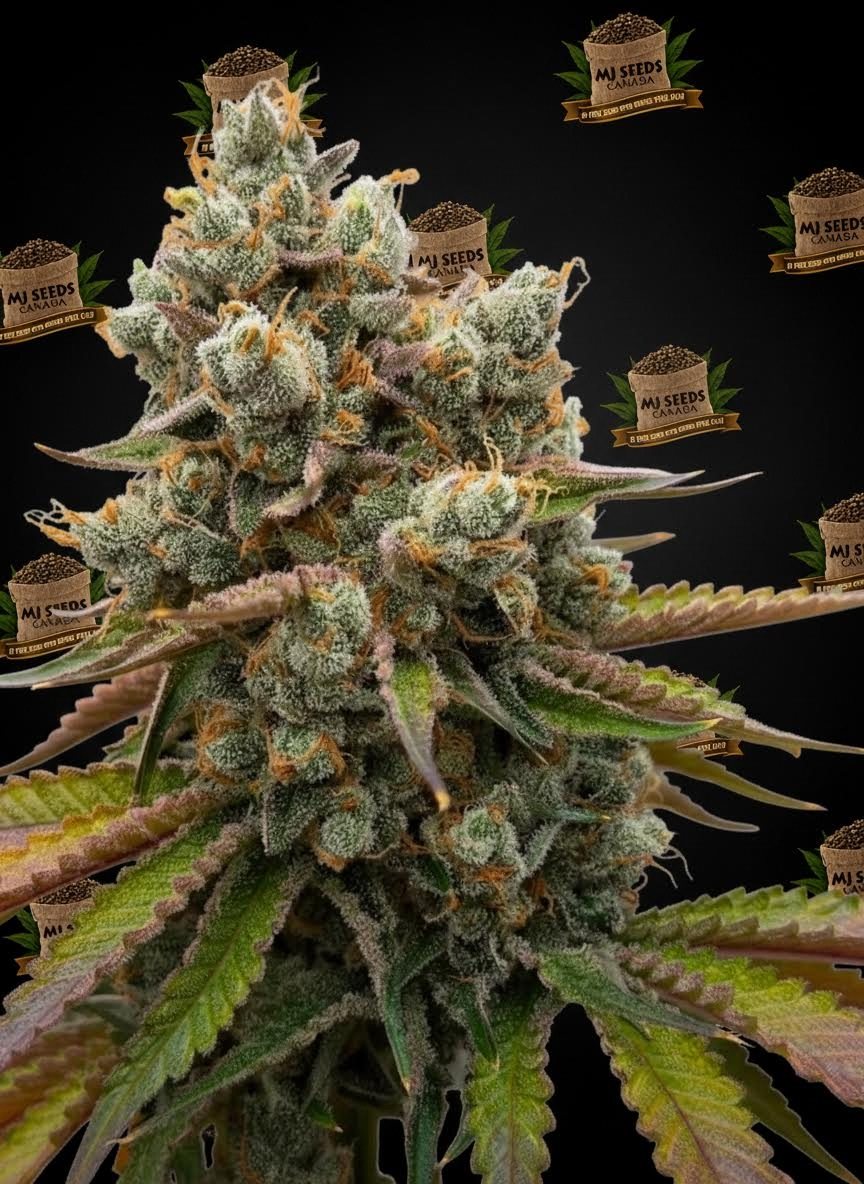
The buds are dense and round, forest green with thick orange pistils and a heavy frost. When nights fall to around 15 degrees in the last two weeks, many plants turn plum and deep violet through the calyxes and sugar leaves, which is why Grape Pie photographs so well.
Grape Pie is a manageable indoor plant with a stretch of roughly 1.5 times. Veg for four weeks, flip at 40 to 50 cm and expect a finished height of 80 to 130 cm. Keep days at 22 to 26 degrees and humidity near 50% in early flower, then drop to 40% to 45% from week six, because the tight buds hold water. It likes a steady, moderate feed with extra calcium and magnesium under LED lights. Most phenotypes finish between day 56 and day 65; a few Durban leaning plants run a week longer.
An 8 to 9 week bloom lets Grape Pie finish across most of southern Canada. In the Okanagan and the Similkameen, a late May transplant is usually ready in the last week of September, and the dry autumn air protects the dense colas. On the Lower Mainland and Vancouver Island it finishes in early October; a rain cover for the final fortnight is cheap insurance. In southern Ontario and Prince Edward County, expect the first week of October. On the Prairies, germinate indoors in April and plant out after the last frost in late May, then keep frost cloth handy for September nights. In the Maritimes, choose a sunny slope with good drainage. Our best outdoor seeds for Canada guide lists other strains that finish in the same window.
Top once at the fifth node and spread the branches under a net; Grape Pie fills a screen evenly and rewards it with six to ten matching colas. Clean out the lower third of the plant a few days before the flip, and thin the inner fan leaves at the start of week three of flower so air moves through the middle.
Colour is not a harvest signal, since purple can appear from week five. Watch the trichomes from day 55 and cut when most are cloudy with 10% to 15% amber for the full two-stage effect. Dry for 10 to 14 days at 60% humidity and 17 to 19 degrees, then cure for at least three weeks. The pastry note is the last to develop and is strongest after a month in the jar.
A trained indoor canopy returns 400 to 500 g/m² of heavy, compact buds that lose little weight in the dry. Outdoors, a plant in a 50 litre fabric pot or in good ground gives 500 to 800 g in a full season, with the top of that range coming from the Okanagan and the Niagara region. It is not a bulk strain, but very little of the harvest is loose or airy.
Grow Grape Pie if you love grape and dark fruit flavours, want an evening strain with a cheerful start, or plan to make your own crosses and want a proven grape parent in the garden. A pack of Grape Pie feminized seeds gives every plant the chance to express that grape and cherry character.
Pick something else if you need a strong daytime effect, want the heaviest possible yield, or grow in a region where early October means steady rain and you cannot cover the plants.
Cherry Pie, the mother, is lighter and fruitier, with more of the Durban lift. Granddaddy Purple, one step further back, is the pure purple indica: heavier, earthier and even sleepier. Grape Gas, a Grape Pie child, trades some of the pastry for fuel and a more balanced effect. Gastro Pop takes the line one more generation and pushes the potency higher. Among our indica feminized seeds, Grape Pie is the grape parent we point to first.
Grape Pie is an indica dominant hybrid, usually rated about 70% indica and 30% sativa. It opens with a happy, talkative lift from the Durban Poison in its background, then settles into a heavy body relaxation that suits the evening. The plant grows medium height with dense, compact buds.
Grape Pie is a cross of Cherry Pie and Grape Stomper. Cherry Pie comes from Granddaddy Purple and Durban Poison, and Grape Stomper is usually listed as Purple Elephant crossed with Chemdawg Sour Diesel. Together they give the grape jam, cherry and pastry flavour.
Grape Pie usually tests between 18% and 25% THC, with CBD under 1%. That is strong but not at the top of the modern range. Most people find a small amount gives a relaxed, happy evening, while a larger dose becomes heavy and sleepy.
Yes, Grape Pie often turns purple, especially when night temperatures drop to around 15 degrees in the last two weeks of flower. Some phenotypes stay mostly green in a warm room. The colour comes from the Granddaddy Purple and Purple Elephant in its family tree.
Many purple strains need nine to ten weeks and a long, dry autumn. Grape Pie gets its colour and its grape flavour in 8 to 9 weeks, which makes it one of the few purple dessert strains that can finish outdoors from the Okanagan to the Maritimes. We ship it from our Vancouver, BC seed bank in plain packaging, and it arrives in 3 to 7 business days. Shipping is free on orders over $200, and $30 adds tracking, insurance and one free reshipment if the parcel goes astray.
We have tested our seed in Vancouver since 2009, and the 80% germination guarantee applies when you start your seeds with the cup of water and paper towel steps in our germination guide. Grape Pie comes in 5, 10 and 25 seed packs, and each 10 or 25 pack is buy one get one free with another strain of the same size, which makes it easy to grow the parent beside one of its grape children. Orders past $420 include 10 extra seeds.
Checkout accepts Interac e-Transfer, credit card, Bitcoin or cash, and if a leaf looks wrong in week six, you can reach us by phone, email, WhatsApp or live chat on any day of the week.
| Pack Size | 5 Seeds, 10 Seeds, 25 Seeds |
|---|---|
| Genetics | Cherry Pie x Grape Stomper |
| Type | Indica dominant hybrid (70/30) |
| THC | 18%–25% |
| CBD | Under 1% |
| Flowering time | 8–9 weeks (56 to 65 days) |
| Outdoor harvest | Late September to early October |
| Height indoor / outdoor | 80–130 cm / up to 180 cm |
| Yield indoor / outdoor | 400–500 g/m² / 500–800 g per plant |
| Difficulty | Moderate |
| Climate | Warm, settled days; a cool night drop in the last fortnight for purple |
| Best for | Grape and pastry flavour, evening use, parent stock for grape crosses |


Are You 18 Or Over?
By clicking 'Continue', you confirm that you are over 18 years old. By using this website, you agree to our Terms of Service.
Reviews
There are no reviews yet.