


Sometimes you look at a handful of cannabis seeds and wonder if they’re even worth testing. That’s normal. Seeds can look “okay” but still be immature, damaged, or too old to sprout. The goal here is simple: learn the most common signs of a healthy, mature seed, and spot the red flags that often mean a seed won’t be viable.
This guide uses beginner-friendly checks like colour, texture, and a few quick tests. None of these is perfect on its own, so you’ll get the best results by combining them.
What does “good” mean for a weed seed?
A “good” seed usually means it’s viable, the embryo inside is alive and has enough stored energy to start growth when conditions are right.
Viability depends on a few things:
- Maturity: Was the seed fully developed before it was collected?
- Integrity: Is the seed coat intact, or is it cracked and weak?
- Storage: Was it kept cool, dark, and dry, or exposed to heat and humidity?
- Age: Older seeds can still be viable, but their success rate often drops over time.
Think of the checks below like a scorecard. The more “good” signs you see, the better the odds.
The Look Test
Colour
Colour is your first big clue, and it usually points to maturity.
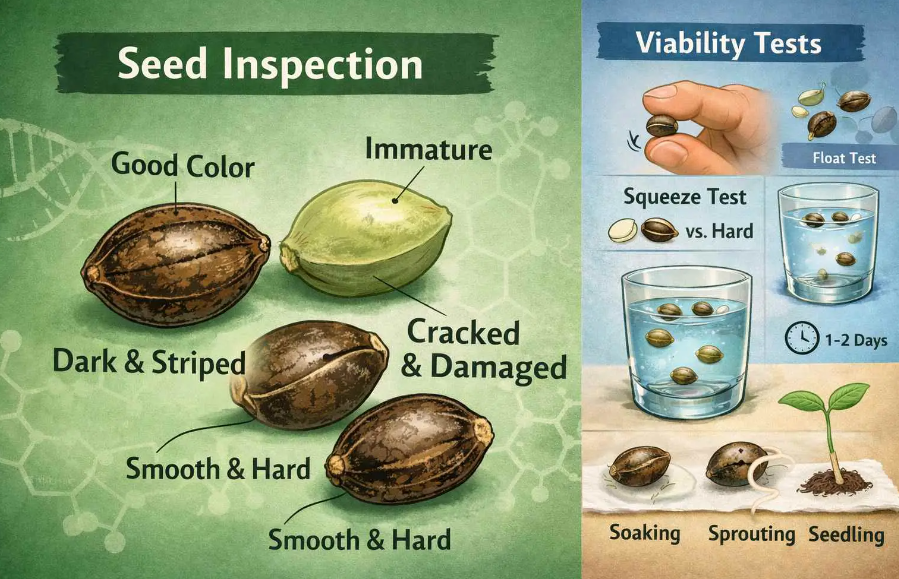
Most healthy cannabis seeds are dark brown, tan, or grey-brown. Some can look almost black. Seeds that are white, pale green, or yellowish are often immature, and immature seeds tend to struggle because their internal structures have not finished forming.
One simple trick is to compare seeds from the same batch. If a few are clearly darker and more “finished” looking, those are often the stronger candidates.
Tiger stripes and mottling
Many good seeds have darker speckles or streaks, often called tiger stripes. Not every strain shows strong striping, so don’t panic if you don’t see it. Still, mottling can be a sign that the seed coat formed properly, which often lines up with maturity.
Sheen
A healthy seed often has a slight waxy sheen. It can look smooth, even a bit glossy, under bright light.
Seeds that look dull, dusty, chalky, or heavily scuffed may have been stored poorly or handled roughly. That doesn’t always mean “dead,” but it can be a warning sign.
Shape
Look for a seed that’s full and rounded. Seeds that look flat, thin, or shrivelled may be underdeveloped or dried out too far. A strong seed usually looks like it has some “weight” to it, even before you touch it.
The Touch Test
The squeeze test
This is one of the best quick checks because it tests physical strength.
Place a seed between your thumb and index finger. Apply firm pressure.
- Good sign: It feels hard and resists crushing.
- Bad sign: It cracks, crumbles, or flattens easily.
A seed coat is meant to protect what’s inside. If the shell fails under gentle pressure, the embryo may already be damaged, or the seed may be hollow and immature.
Be careful not to squeeze too hard. You want firm pressure, not full force.
Texture and surface damage
Run the seed lightly between your fingers.
A healthier seed often feels:
- Smooth
- Solid
- Free of deep pits or cracks
Red flags include:
- Visible cracks
- Small holes (possible pest damage)
- Craters or chips on the shell
Even a tiny crack can matter because it lets moisture and microbes reach the embryo more easily.
The Float Test
The float test is popular because it feels simple. It can help, but it’s not foolproof, so treat it like one clue, not the final answer.
Here’s the idea: a viable seed is often denser, so it’s more likely to sink in water. A seed that’s hollow or dried out can trap air and float.
How it’s usually done: seeds are placed in a glass of lukewarm water and observed for about 1–2 hours.
How to read results:
- Often viable: sinks
- Often less viable: floats
But there are important limits:
- Some viable seeds float at first because air sticks to the seed coat.
- Some seeds sink later after wetting evenly.
- Leaving seeds in water too long can cause problems like rot.
So if you use this test, keep it short and only use it as a supporting sign.
Storage and Age Clues
A seed can start out strong and still become non-viable if it’s stored poorly. Seeds are living tissue in a resting state, and time slowly wears them down.
What good storage usually looks like
Seeds tend to last longer when they’re kept:
- Cool
- Dark
- Dry
- Stable (not constantly warming and cooling)
Heat and humidity are common seed killers. A seed left in a hot room, near sunlight, or in a damp place can lose viability much faster.
Sound and “weight” clues
Some people do a simple comparison test by dropping a seed gently onto a hard surface. A solid seed may make a sharper “click,” while a hollow seed can sound duller.
This isn’t a scientific test, but it can help when comparing seeds from the same batch, especially if some look and feel lighter.
If a seed already looks cracked, skip any drop tests. You don’t want to damage it further.
Quick guide: good vs bad weed seeds
| Feature | More likely good (viable) | More likely bad (non-viable) |
| Colour | Dark brown/tan, sometimes striped | White, pale green, yellowish |
| Surface | Smooth, slight sheen | Dusty, dull, heavily scuffed |
| Shape | Full, rounded | Flat, shrivelled |
| Squeeze test | Stays intact | Cracks, crumbles, flattens |
| Float test | Often sinks | Often floats |
If a seed looks great but fails the squeeze test, that’s a bigger concern than missing stripes. Strength usually matters more than pattern.
Conclusion
Good cannabis seeds usually show signs of maturity and strength. Look for a darker colour, a smooth shell with a slight sheen, and a full, rounded shape. Then confirm with the touch test, a viable seed should feel hard and stay intact when gently squeezed. The float test can add another clue, but it’s not perfect, so don’t rely on it alone.
If you stack these checks together, you’ll be able to sort strong-looking seeds from the ones that are more likely to fail, without guesswork.
Frequently asked questions
What colour should a healthy weed seed be?
Most viable seeds are darker shades like brown or tan. Pale green, white, or yellowish seeds are often immature.
Do tiger stripes always mean the seed is good?
Not always, but they can be a helpful maturity sign. Some healthy seeds don’t show strong stripes, so it’s better to judge using multiple signs.
Should a weed seed be hard or soft?
Hard. A good seed usually feels solid and resists pressure. If it crushes easily, it’s more likely immature, hollow, or dead.
If a seed floats, is it automatically bad?
No. Some viable seeds float at first. Floating can be a warning sign, but it should be checked alongside colour, shape, and hardness.
Can old seeds still be viable?
Sometimes, yes, especially if they were stored in a cool, dark, dry place. But in general, viability often decreases with age.
What’s the biggest red flag to watch for?
Cracks or a seed that crumbles in the squeeze test. Physical damage is one of the clearest signs that a seed may not be viable.
Is there a single test that’s 100% accurate?
The only sure way is whether it successfully sprouts, but the look test and squeeze test are the most reliable early indicators you can do quickly.