


Cannabis seeds are small, tough, and easy to miss if you don’t know what you’re looking for. At first glance, they can look like tiny pebbles or mini nuts. But when you look closer, you’ll notice a few telltale traits, like their shape, colour, and surface patterns.
This guide breaks down cannabis seed appearance in a simple way. You’ll learn the common look of a mature seed, what “tiger stripes” really mean, and which visual signs often point to an immature or damaged seed.
What are cannabis seeds?
Cannabis seeds are the plant’s starting point. They’re designed to protect a living embryo (a baby plant) and keep it safe until conditions are right for growth.
A seed has two main “jobs”:
- Protection: a hard shell shields what’s inside.
- Fuel: stored energy helps the embryo survive early development.
From the outside, you mostly see the shell, which is why appearance is all about texture, shape, and colour.
What a healthy seed usually looks like
A mature cannabis seed often looks like a tiny teardrop or egg.
Most have:
- Size: about 2 mm to 5 mm long, similar to a peppercorn or matchstick head
- Shape: oval with one end slightly pointed
- Shell: firm and hard, not squishy
- Surface: smooth to slightly textured, sometimes with a waxy shine
You’ll also often see a faint line along one side, like a seam. That’s normal.
Shape and texture: the easiest things to spot
The teardrop shape
Cannabis seeds are usually ovate, meaning rounded on one end and gently pointed on the other. They’re not perfectly round, and they’re rarely flat.
If a seed looks very thin or “collapsed,” that can be a sign it didn’t develop fully.
The shell feel
The outer shell is called the testa. A mature seed coat feels tough because it’s built to protect the embryo from bumps, drying, and other stress.
When you handle a seed, it often feels:
- Dry (not sticky)
- Solid (not soft)
- Smooth with tiny natural texture lines
Some seeds also have a slight shine, like a polished grain.
Colour and patterns: what’s normal, what’s not
Common mature seed colours
Healthy-looking mature seeds are often:
- Tan
- Medium brown
- Dark brown
- Grey-brown
You might see a mix of shades on one seed. That’s normal.
Lighter colours can mean immaturity
Seeds that look pale white, cream, or bright green are often immature. They can appear soft or “unfinished,” like the shell didn’t fully harden.
Mottling and “tiger stripes”
Many mature cannabis seeds have darker streaks or spots over a lighter background. People call these tiger stripes. The markings can look like:
- Thin dark lines
- Random speckles
- Patchy marbling
This pattern is common, but it’s not a guarantee of anything by itself. Think of it as a “maturity clue,” not a quality badge.
The tiger stripe myth: what those stripes do and don’t tell you
A lot of people assume stripes mean:
- stronger genetics
- higher potency
- a certain “type” of plant
But seed markings can’t tell you any of that.
Those stripes are surface-level features of the seed coat. They can show the seed matured properly, but they don’t reveal THC levels, plant sex, or strain traits. Two seeds can look almost identical and still grow into very different plants because genetics aren’t visible on the shell.
Quick quality cues: how people judge seeds by sight
You can’t see inside a seed without breaking it open, so most “quality checks” are really just common-sense visual cues.
What a mature, well-formed seed often shows
- Plump, rounded shape
- Firm shell
- Brown/grey-brown tones
- Slight sheen (sometimes)
- Natural mottling or striping (sometimes)
What can hint at a weak or damaged seed
- Very pale colour (white/green)
- Cracks, chips, or splits
- Flat or shriveled shape
- Very dull, dusty look
- Soft shell that dents easily
A cracked shell matters because it can expose the embryo or let moisture in and out too quickly.
Why seeds can look different (even when they’re fine)
Not all seeds look the same, and that doesn’t automatically mean something’s wrong. Appearance changes for a few reasons:
- Natural variation: genetics can influence shell tone and pattern
- Age: older seeds may look duller and less glossy
- Storage: heat and humidity changes can affect the shell surface
- Handling: rough movement can chip or scuff the coat
So instead of focusing on one trait, look at the “full picture” of shape, firmness, and shell condition.
Do feminized, regular, and autoflower seeds look different?
Most of the time, no, not in a reliable way.
Regular seeds
These come from natural pollination between a male and female plant. They look like typical cannabis seeds.
Feminized seeds
From the outside, feminized seeds usually look the same as regular seeds. You can’t confirm feminization by colour, size, or stripes.
Autoflower seeds
Some people say autoflower seeds can be smaller, but this isn’t consistent. Seed size varies widely across genetics, so appearance alone can’t confirm it.
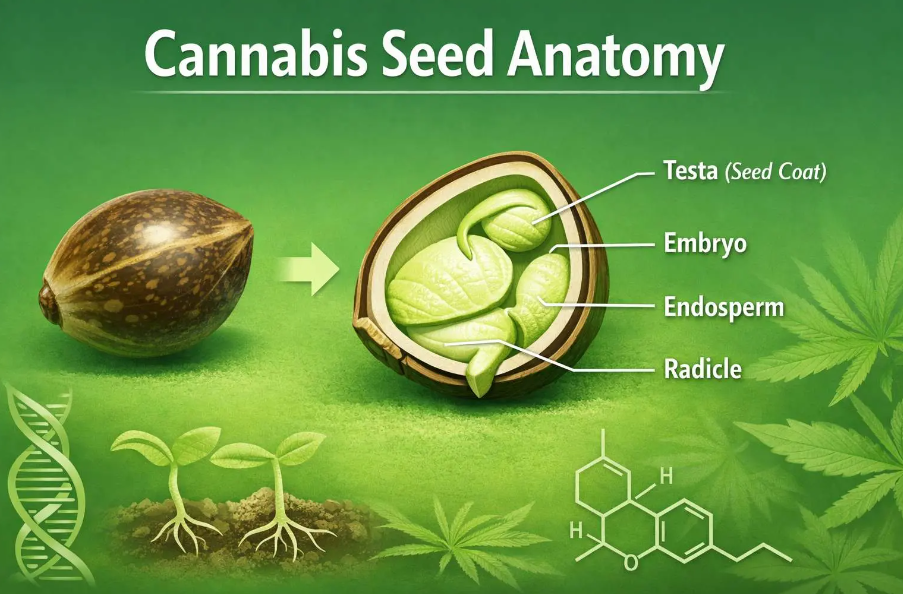
Simple seed anatomy (light science, easy to follow)
If you want the “what’s inside” view, here are the key parts, explained simply.
Testa (seed coat)
The testa is the hard outer shell. It protects the inner parts from physical damage and drying.
Embryo
The embryo is the baby plant, dormant inside the seed.
Endosperm
The endosperm is stored food. It fuels the embryo early on.
Radicle
The radicle becomes the first root during early development.
This is why the shell matters so much. It’s guarding living tissue and the food supply that keeps it going at the start.
Tips for identifying cannabis seeds at a glance
If you’re looking at seeds and trying to describe what you see, use this quick checklist.
- Check the outline. Is it teardrop-shaped and plump, or flat and collapsed?
- Look at the colour. Brown and grey-brown shades are common for mature seeds.
- Notice the surface. Light mottling is normal. Deep cracks are not.
- Scan for damage. Chips near the seam can matter more than small surface scuffs.
- Don’t overrate stripes. They’re common, but they don’t “prove” anything about genetics.
Conclusion
Cannabis seeds usually look like tiny teardrop-shaped nuts, around 2 mm to 5 mm long, with a hard shell and a faint seam on one side. Mature seeds are often brown or grey-brown and may have mottled “tiger stripe” markings. Pale white or green seeds often look less developed, while cracked, flat, or shriveled seeds can show damage or poor development.
If you’re trying to describe what you’re seeing, focus on the basics: shape, firmness, and shell condition. Patterns can be interesting, but they’re not a shortcut to genetics.
Frequently Asked Questions
Can you tell if a cannabis seed is “good” just by looking at it?
You can make an educated guess, but you can’t be 100% sure by appearance alone. Visual cues like a firm shell, plump shape, and mature colour are helpful, but they aren’t perfect.
What do immature cannabis seeds look like?
Immature seeds often look pale (white/cream) or bright green. They can also look soft, thin, or underdeveloped compared to mature brown seeds.
Do tiger stripes mean the seed is higher quality?
Not necessarily. Tiger stripes can be a sign of maturity, but they don’t guarantee anything about potency, plant sex, or strain traits.
Are darker cannabis seeds always better?
Darker seeds are often more mature, but colour varies naturally. A medium-brown seed can be just as normal-looking as a darker one if it’s plump and intact.
Can you tell feminized seeds from regular seeds by appearance?
No. Feminized and regular seeds usually look the same from the outside.
Are autoflower seeds easy to spot by size?
Not reliably. Some are smaller, some aren’t. Size alone can’t confirm seed type.
What’s the “seam” line on the seed?
That faint ridge is part of the seed coat structure. It’s normal and often visible on mature seeds.