

Buying cannabis seeds in 2026 feels more confusing than it should. Search results often mix Canadian rules with U.S. rules, and you’ll see phrases like “souvenir seeds” or “stealth shipping” used as if they’re normal everywhere. In Canada, seed buying sits inside a legal framework, and the safest way to think about it is simple: the best place to buy seeds is the place that fits Canadian law, your province’s rules, and basic product quality checks.
This guide breaks down the main buying options in Canada, the legal details that affect seeds, the science and quality factors that matter, and the myths that often lead people in the wrong direction.
Quick definitions
- Cannabis seeds are the plant’s reproductive units. They can be sold through regulated cannabis retail systems in Canada.
- Seed viability means the seed is alive and capable of sprouting under proper conditions.
- Genetics refers to the inherited traits that influence growth patterns, flowering behaviour, and chemical output (like cannabinoid and terpene profiles).
The legal details that change “where to buy”
Myth: “Seeds are always legal because they have 0% THC”
Reality: That “0% THC” point shows up in other countries as a reason seeds may be treated as collectibles. In Canada, cannabis is federally regulated, and seeds fit under that regulated system. So legality is not just about THC content. It’s about the retail pathway and provincial rules.
Public possession and seed counts
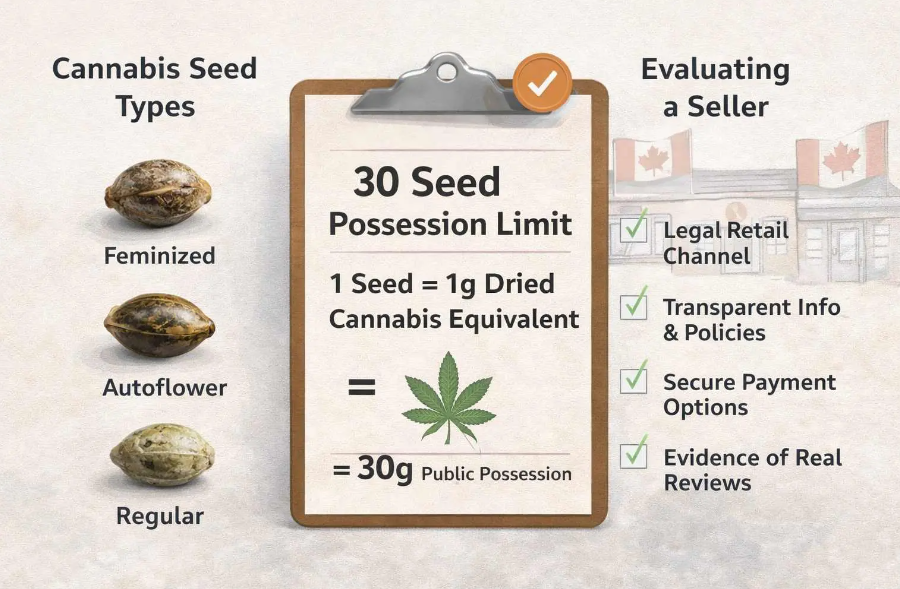
Canada uses “dried cannabis equivalent” rules for public possession. In the rules summarized in your legal reference, one seed is treated as the equivalent of one gram of dried cannabis for public possession math. That means the typical public limit of 30 grams of dried cannabis aligns with about 30 seeds in public. This matters if you’re travelling with seeds or buying larger packs.
Home grow is not the same everywhere
Even though cannabis is legal federally, provinces can restrict home cultivation. Quebec, for example, bans home growing, and that ban was upheld by the Supreme Court of Canada. Manitoba allows home growing again, but with important conditions like growing indoors and controlling access. So “where to buy” should always be matched with “what’s allowed where you live.”
The main places Canadians buy cannabis seeds
1) Provincial online cannabis stores
Many provinces and territories operate an official online store or an official distribution system for legal cannabis products. Buying seeds this way usually means:
- product listings are standardized and easier to compare
- age gates and payment systems are built for legal retail
- supply chains are tied to licensed producers and regulated distribution
For a reader who wants the most legally straightforward option, this is typically the cleanest path.
2) Licensed private retailers (where permitted)
In provinces with private retail models, licensed stores still sit inside the regulated system. The difference is that the storefront is privately owned, but licensing and supply are controlled by provincial rules. A practical check is whether the retailer clearly shows licensing or official identifiers connected to provincial regulation.
3) Producer-direct or “farmgate” models (limited and location-specific)
Some provinces allow certain producer-direct sales models in specific contexts. Availability varies and can change, but the key point is the same: it’s still a regulated pathway when it’s permitted.
A research checklist for spotting a reputable seed source
The internet has thousands of seed listings. Many are fine, many are low-effort resellers, and some are scams. If you want a research-leaning approach, focus on verifiable signals.
Signal 1: Traceability beats hype
The strongest signal is a source tied to regulated systems. Outside that, look for clear business identity and consistent policies. Scam sites often have:
- vague contact information
- copy-pasted strain descriptions
- “too good to be true” promises with no evidence
Signal 2: Payment methods tell you about risk
A common scam pattern is forcing payment methods that are hard to reverse. From a consumer safety angle, secure checkout and normal buyer protections matter. The goal isn’t to judge payment choices; it’s to avoid situations where you have no recourse if nothing arrives.
Signal 3: Reviews should be specific, not perfect
Use third-party reviews and forum discussions, but read for patterns. Useful reviews mention details like:
- delivery reliability (not just “fast”)
- seed condition on arrival
- whether the seller handled issues consistently
Overly polished, repetitive reviews can be a sign of marketing rather than real feedback.
Signal 4: “Stealth shipping” is not a quality badge
You’ll see stealth shipping marketed as a feature, with seeds hidden in everyday items to reduce customs issues. That is a clue that the shipment expects border friction. In a Canadian context, it’s smarter to prioritize domestic regulated options rather than treating stealth shipping like a normal standard.
Seed types and why “where you buy” affects what you get
A lot of buying regret comes from mismatched expectations. People think they bought “good seeds,” but they really bought the wrong type for their situation. Even in simple language, the science here is about predictability.
Feminized seeds
Feminized seeds are bred to produce female plants most of the time. That’s important because female plants are typically the ones that develop the flower structure people associate with cannabis products. For many hobby growers, feminized seeds reduce uncertainty.
Autoflower seeds
Autoflower seeds shift into flowering based on age, not on light schedule. That can make timing more predictable. In a country with wide seasonal variation, predictability is one reason autoflowers get attention.
Regular seeds
Regular seeds can produce male or female plants. That’s useful for breeding projects, but it adds complexity if someone expects a uniform result.
The 2026 trend: stability and consistency claims
Some sellers emphasize “stability” in genetics. The science idea is simple: more stable lines should show less variation in traits across plants. But stability is not magic. Environment still matters (light, temperature, nutrients, stress). When evaluating these claims, look for clear descriptions and consistent documentation, not buzzwords.
A simple seed quality check when your package arrives
You can’t fully “lab test” seeds at home, but you can spot obvious problems.
Healthy-looking seeds often are:
- dark brown or tiger-striped
- firm and hard-shelled
- intact, not cracked
Seeds that may be immature or damaged often are:
- pale (green or white)
- soft or squishy
- cracked or split
Storage matters too. Seeds last longer when kept cool, dark, and dry. A small airtight container stored away from heat and moisture helps slow down ageing.
How to keep seed content informational and policy-safe
Some online content gets into trouble because it reads like a shopping guide or a “how to acquire” manual. If you’re researching or if you’re writing about buying seeds, safer informational framing usually looks like:
- explaining legal pathways (provincial stores, licensed retailers)
- teaching legitimacy checks (traceability, reviews, payment safety)
- defining seed categories and quality signals
It avoids aggressive “buy now” language, price pushing, or detailed tactics that enable bypassing controls. That aligns better with content policy expectations for drug-related topics.
Conclusion
In Canada, “where to buy cannabis seeds” isn’t just a shopping question, it’s a legal-and-quality question. Start with your province’s rules, since home cultivation and retail systems can differ. Treat regulated provincial stores and licensed retailers as the most straightforward sources.
If you’re comparing online options, use evidence-based signals: traceability, clear business policies, safe payment systems, and reviews that show consistent real-world outcomes. Finally, remember the biology piece, seed type and seed quality influence predictability, and even strong genetics still depend on the environment.
Frequently Asked Questions
Are cannabis seeds legal to buy in Canada?
Seeds are regulated as cannabis products. A straightforward way to stay aligned with Canadian rules is buying through legal provincial systems and licensed retailers.
How many seeds can I carry in public?
Under the dried-cannabis equivalent approach described in your legal reference, one seed counts as one gram of dried cannabis for public possession calculations, which lines up with the common 30-gram public limit.
Can I grow cannabis at home in every province?
No. Home grow rules vary by province. Quebec bans home growing, and that ban was upheld by the Supreme Court of Canada. Manitoba allows home cultivation again but sets conditions like indoor growing and controlled access. Always confirm the current rule where you live.
Are “souvenir seeds” a thing in Canada?
That framing is more common in other regions where seed possession is treated differently from cultivation. In Canada, it’s safer to focus on regulated retail pathways rather than relying on loophole-style language.
Is stealth shipping a sign that a seller is “good”?
Not really. Stealth shipping mostly signals that a shipment expects border or customs friction. It doesn’t prove genetic quality, and it can increase risk.
What seed type is most predictable?
In general terms, feminized seeds are designed to reduce sex-based uncertainty, and autoflowers are designed for age-based flowering. Regular seeds can be less predictable because they may produce males or females.