
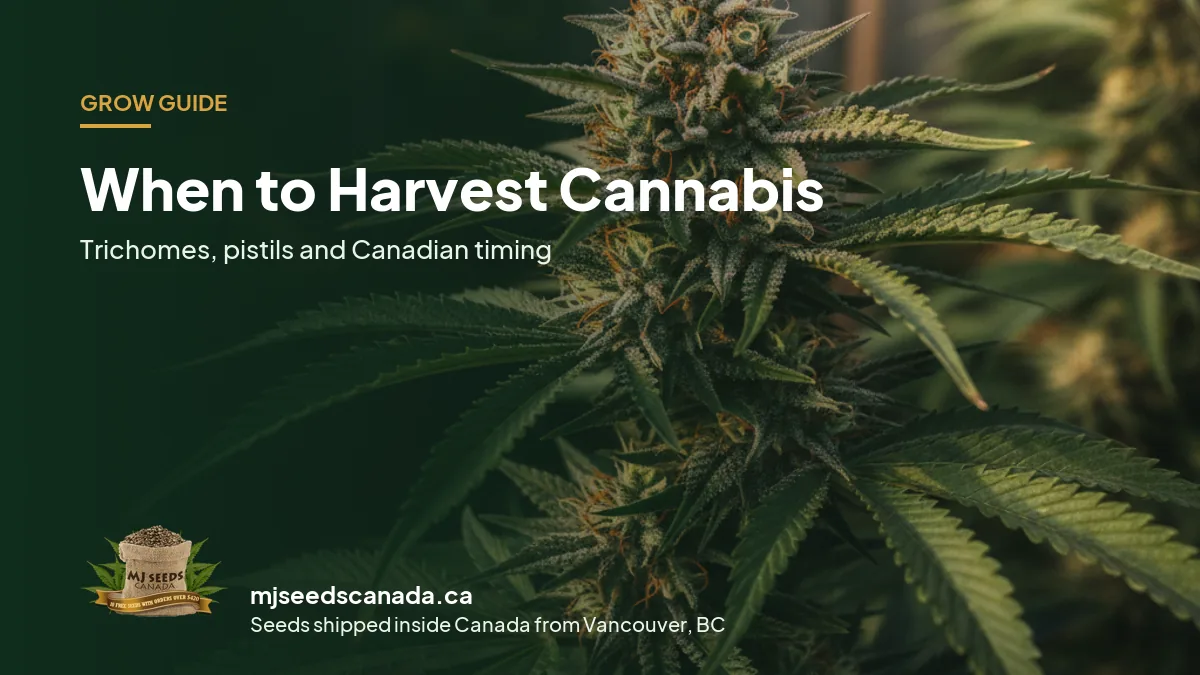
Harvest cannabis when most of the trichomes on the buds (not the sugar leaves) have turned milky white and about 10% to 20% have turned amber, which for most strains is 8 to 10 weeks after flowering starts.
Last updated: November 2026
This guide is for anyone looking at a plant in late flower and wondering if it is time. It explains the three signs that matter (trichomes, pistils and the calyxes), how to check them with a cheap loupe, how the timing changes the effect, and what to do when a frost or a week of rain forces your hand.
Canada adds its own pressure. Outdoor plants here finish in late September or October, right when nights drop toward zero and the fall rain arrives, so many growers are tempted to cut early. Knowing exactly what ripe looks like lets you decide with confidence whether to wait three more days or bring the plant in tonight.
Cannabis is ready to harvest when the trichomes on the buds have turned from clear to milky white, a share of them have started to turn amber, most pistils have darkened and curled in, and the calyxes look swollen. Trichomes are the most reliable of those signs, because they track the resin itself rather than the plant’s outward look.
Check all three before you cut:
The breeder’s flowering time tells you when to start checking, not when to cut. Two plants from the same pack can finish a week apart.
At harvest, most trichome heads should look milky or cloudy, with roughly 10% to 20% amber for a balanced effect. Clear heads mean the plant needs more time. Look at the trichomes on the calyxes, not on the sugar leaves, because leaf trichomes often turn amber a week or more before the buds do.
| Trichome colour | What it means | What to do |
|---|---|---|
| Mostly clear | Resin still developing | Wait. Check again in 4 to 5 days. |
| About half clear, half cloudy | Getting close | Check every 2 days. Start planning your dry space. |
| Mostly cloudy, under 5% amber | Early window: the most uplifting, clear headed result | Harvest if you prefer a lively, daytime effect. |
| Mostly cloudy, 10% to 20% amber | Peak window for most growers | Harvest for a balanced effect and full flavour. |
| 30% amber or more | Late window: heavier and sleepier | Harvest now if you want an evening effect; do not wait longer. |
The change from clear to cloudy happens over one to two weeks; cloudy to amber can move faster, sometimes 10% in four or five warm days. That is why daily checks in the final week pay off.
You can judge harvest without a microscope by using a 60x jeweller’s loupe or a clip-on phone macro lens, which cost under $20 and show trichome colour clearly. If you have no magnifier at all, use the pistils and calyxes: when 70% to 90% of the pistils have darkened and curled in and the calyxes are fat and tight, the plant is usually within a week of ready.
Some practical tips for reading trichomes:
Pistils alone can mislead. Heat, a light leak or heavy rain can turn pistils brown early, and some strains keep pushing fresh white hairs late in flower. Use them as a second opinion, not the deciding sign.
Yes, harvest timing shifts the effect noticeably. An earlier harvest, with almost no amber, usually feels brighter, more energetic and more head focused. A later harvest, with 25% amber or more, tends to feel heavier in the body and more sleepy, because some of the THC has started to break down into CBN as trichomes age.
That gives you a little control over the same plant. Sativa dominant strains are often cut in the early window to keep their lively character, while growers who want an evening jar from an indica wait for more amber. Flavour peaks with the cloudy stage; very late harvests can taste flatter as the terpenes fade.
Outdoor photoperiod cannabis in Canada is usually harvested between mid September and mid October, depending on the strain’s flowering time and how mild your autumn is. Plants start flowering when nights lengthen in late July or early August, so an 8 week strain finishes around late September and a 10 week strain around mid October.
| Region | Typical outdoor harvest | Best fit |
|---|---|---|
| BC coast and Vancouver Island | Late September to mid October | Most strains up to 10 weeks; rain cover advised |
| Okanagan and BC Interior valleys | Mid September to early October | 8 to 9 week strains; dry, warm autumns |
| Prairies | Early to late September | Autoflowers, fast versions and 7 to 8 week strains |
| Southern Ontario | Late September to mid October | Up to 9 or 10 weeks in warm years |
| Atlantic provinces | Late September to early October | 8 to 9 week strains in sheltered, sunny spots |
| Northern regions | Late August to mid September | Autoflowers or greenhouse growing |
These are typical windows, not promises. A cold September can add a week, and a hot one can bring harvest forward. Remember the legal side too: adults can grow up to four plants per household under the Cannabis Act, Quebec prohibits home growing, and Manitoba allows four plants indoors only. Health Canada’s page on growing cannabis at home safely covers storage and security once the crop is in.
A light frost of zero to minus 1 degree rarely ruins a mature plant, but a hard frost below minus 2 can damage buds and leaves, so harvest before it if the trichomes are mostly cloudy. If the plant is still mostly clear, cover it overnight with a frost blanket or move the pot into a garage or shed and put it back out in the morning.
Rain is the bigger risk in much of Canada. Dense buds that stay wet for days invite bud rot (grey mould), which spreads from the inside out. If a week of rain is forecast and the plant is in the early harvest window, cutting a few days early is better than losing whole colas. Look inside the largest buds for grey, mushy spots before and after every wet spell.
Autoflowering cannabis is harvested by the same trichome signs, usually 9 to 12 weeks after the seed sprouts. Because autos run on age rather than light, the calendar from seed matters more than the date, and an auto planted outdoors in late May is often ready in August, well before frost anywhere in southern Canada.
Autos can ripen unevenly: the main cola may be ready a week before the lower branches. That is a good case for a staged harvest.
Yes, you can harvest cannabis in stages by cutting the ripe top colas first and leaving the lower buds for 5 to 10 more days. Removing the tops lets more light reach the lower branches, which then swell and ripen. It is a useful method for tall sativas, autos and outdoor plants where the top and bottom of the plant finish at different times.
Keep the plant on its normal schedule while the rest finishes, and dry each cut separately so you can compare them.
Harvesting too early gives smaller, lighter buds with lower potency and a grassy, thin flavour, because the plant has not finished building resin. Under ripe buds are also airier and lose more weight when drying. Harvesting too late gives a heavier, sleepier effect, a flatter taste, and on outdoor plants a higher risk of mould.
Of the two, a few days late is usually the smaller mistake indoors; outdoors in a wet Canadian October, a few days early is usually the safer bet.
Prepare for harvest in the final two weeks by lowering humidity, planning your drying space and, if you feed salts, deciding whether to flush. These steps protect the quality you have spent months building.
If you want the bigger picture of what happens before this point, our flowering stage week by week guide covers each week from the flip to harvest.
Harvest timing in one minute
You can, but it usually means the plant is not ready. If many pistils are still white and straight, the buds are still growing. Check the trichomes: if they are mostly clear, wait. If they are mostly cloudy despite white hairs, the strain may simply keep pushing new pistils late.
Most plants are ready one to two weeks after 70% to 90% of the pistils have turned brown or orange. Pistils are only a rough guide, so confirm with a loupe. Mostly cloudy trichomes with some amber mean it is time.
Many growers harvest at the end of the dark period or early in the morning, before the lights or sun warm the plant. The idea is that terpenes are slightly higher then. The difference is small, so convenience and dry weather matter more outdoors.
Most photoperiod strains are ready 8 to 10 weeks after flowering starts, or roughly 3 to 5 months from seed. Autoflowers are usually ready 9 to 12 weeks from sprouting. Always confirm with the trichomes rather than the calendar.
Yes, it can be re-vegged by leaving some lower buds and leaves and giving it 18 or more hours of light. Re-vegging takes several weeks and the regrowth is often uneven. Most home growers find it simpler to start a new seed.
The outdoor harvest season in Canada runs from about mid September to mid October for photoperiod strains. Autoflowers planted in late May can be ready in August. The exact date depends on the strain and your region.
Every seed we sell is already in Canada: it ships from Vancouver in plain packaging and arrives in 3 to 7 business days, so you can plan next season’s harvest early. Browse our autoflowering seeds for the easiest Canadian outdoor finish.
You must be of legal age to view cannabis seed content in your region.
By entering you agree to our Terms of Service.
Same pack size, any strain. It ships with the rest of your order.